Thursday, 3 February 2022

Joburg and Pilanesberg

As I had the motorcycle with me and the bakkie was beginning to make expensive noises again, I spent quite a bit of time reacquainting myself with the suburbs around the city.  Braamfontein was mostly deserted due to a combination of covid and Christmas and driving past the State Theatre I noticed this odd construction.  Have yet to find out what it housed but there was a huge coat of arms on the second floor so assume it belongs to the government.  I'm sure they would happily accept something that looks like a cross between a crown and a wedding cake!


Moving into Upper Houghton the imposing heap that is part of King Edward School could easily be mistaken for Union Buildings in Pretoria........


........and of course Sandton just has to be over the top.

One fascinating touch was this vertical garden on the front wall of an office block.


Emmarentia Dam surrounded the Johannesburg Botannical Garden provides a welcome break from concrete....

.....while this impressive piece of overkill has popped up next to Gold Reef City - could be back in Dubai.

My sister has been feeding several strays and their number was boosted by the arrival this mom and no less than five kittens.

The knock in the bakkie's engine was becoming serious and as the guarantee for the injector rebuild was from a Durban company, I decided to delay my trip to Pilanesburg and see if I could get back there before something serious happened. As it was just after Christmas the N3 was fairly hectic but most of the traffic was coming the other way.  After the vast flatness of the Free State, the koppies around Harrismith are always a welcome sight.

Midmar Dam was an immense waterfall after the heavy rains and spilling to a greater degree than I have ever witnessed before.

The Turner's very kindly allowed me to christen the newly finished glamping tent and I was pleasantly surprised that all the plumbing and electrics that I'd installed were behaving........


.....and how many other places in the world feature a forest and a stream at the bottom of the garden.


Fortunately the knock stemmed from an electrical fault that was soon sorted and I headed back to the Highveld.  The accommodation at Manyane resort was a bit disappointing as were the surrounds, but the fountains at the pool still worked though one was pointing in an odd direction.  The rest of the park is nothing short of disgusting........


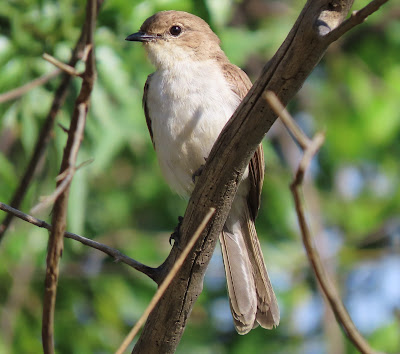
.......though the birdlife is still good.  Found this little Marico flycatcher still hunting next to the road.......


......and this very agitated diederik cuckoo arguing with another male over who had rights to the red-breasted swallow's nest nearby.  These are possibly the most successful cuckoos on the planet with well over 20 species being parasitised. The females are even capable of matching the colour of eggs of the host species that raised them!


Said swallows didn't seem to know what the fuss was about anyway!


Breakfast was included in the exorbitant rate and the friendly cat here obviously does very well on table scraps.


Back in the park a flock of European bee-eaters were making short work of their favoured prey and I managed to get a shot of their other side which is normally ignored as photographers seem to prefer the blue belly.  A superb creature whichever way you view it.


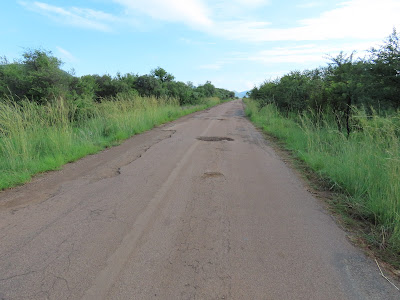
Did I mention the "roads"?  That line about  - 'In some countries they drive on the left, here we drive on what's left' - is extremely appropriate.


Had heard this ultralight flying about and assume the occupants must be counting what's left of the game.


The main part of the reserve is situated in an old volcanic crater with a large dam in the middle and is still very pretty, but I doubt the overseas visitors staying at Sun City are very impressed with the infrastructure.  Such a pity.


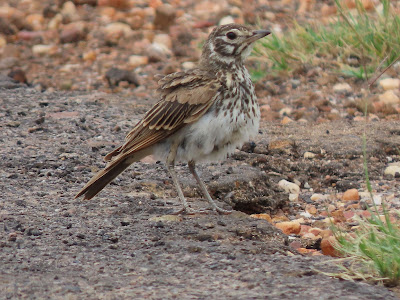
I nearly ran off the road when I saw this dusky lark casually ambling along no more than 5 metres from my lens. It's a migrant and I have only seen it on two previous occasions, so always a pleasure.  What looks like a claw sticking out of it's back is only a feather that's been lifted by the breeze!


The only photograph I've ever managed to get was sketchy in the extreme so here are a couple which show all the distinctive features.  Yes I know it's dull but it is RARE.


Near the main dam a couple of pans had filled which provided an ideal roost for a little egret.  Back in the 1920,s they were almost hunted to extinction as the feathers were highly fashionable on ladies millinery.


My word but this grass is long chaps............


............not really, they are all sitting down.  Some parts of the park are liberally sprinkled with rocks that could rival those near my birth place in the Matopos.


Eventually found a couple of rhinos, dehorned sadly.........


...............and a few hippo doing what hippos do best.


In one corner of their wallow on an overhanging bush, the nest of a grey tree frog.  The female whips up a lather similar to beaten egg-white and deposits her spawn therein, where they safely see out their first few days then drop into the water below..................if it hasn't dried up by then!


The camp had a fair selection of birds including this red-billed hornbill.................


.............and a very intent woodland kingfisher, whose wings may be cobalt, cerulean or just sky blue but stunning would suffice.


Near my cottage a Pride of the Cape Bauhinia galpinii was smothered in orange bloom.


Monday, 27 December 2021

Boksburg ho

 Birding wise, November was a good month and featured two species that I'd never seen before or lifers.  The first was the 30th record of a golden pipit in the southern African region.  A native of eastern Africa mainly Ethiopia, Kenya, Tanzania and Uganda and only a rare vagrant this far south.  What a magnificent creature though and probably the easiest rarity I've ever found.  Google maps lead me straight the spot he had chosen near Albert Falls and he was doing his level best to attract a lady........


....with an impressive song and aerial display.  Had to feel sorry for the little guy as there was absolutely zero chance of that happening.


Down in the Point area of Durban a massive cruise ship terminal has materialized within the last year or so


Particularly noticeable were the pom pom trees Dais cotinifolia which were absolutely smothered in flowers.


The second lifer was found after a long search at the ponds near Sappi's Stanger factory.  Apologies for the quality but the bird was so far away it was impossible to see with binoculars and a positive ID could only be obtained by using the camera and enlarging the pictures.  I'm happy to admit that had the minute differences not been pointed out by an expert, I would never have been able to differentiate a white-rumped sandpiper from the many little stint that accompanied it.  I wont bore you with the details but the bird in the foreground is the sandpiper and the one behind a stint. 


A pity that they gave the job of making this sign to someone who knew absolutely nothing about the subject.  The bird shown, a willow tit, only occurs in the northern hemisphere!


Having a sundowner with the Turners one evening, we were privileged to see a little tambourine dove foraging in the garden - which gives an indication of not only how well treed the garden is, but also how indigenous.


Another visit to the Inanda Dam, seen here from a small reserve in Crestholme......


........provided, as usual, a good variety of birds, including this young Diederik cuckoo.......


.........and flowers like this twisted-petal orchid Eulophia streopetala (thanks Richard).


The drive back to Kloof provided another view of the dam near the wall.


On a favourite walk in the Everton section of the Kloof Gorge the birds were quiet but a light mist made the forest quite eerie.

The almost continuous rain brought out the millipedes including this monster which was at least 150 mm long.


With Christmas around the corner it was time to head back to the 'Berg to put the Beast into storage and make the pilgrimage to Boksburg.  An indication of just how much rain has been falling was the Waggondrift Dam which not only had the floodgate open but was spilling as well, something I don't recall ever experiencing.


Hlahlanathi is to my mind the most outstanding caravan park in the southern 'Berg and it's situated close to Oliviershoek Pass, motorcycle Nirvana if ever there was.  On an overcast day, a sudden break in the clouds highlighted this hill with it's row of rock outcrops that must surely have sheltered the San bushmen in days past.


More evidence of unusual amount of precipitation was evident at the top of the pass where the Sterkfontain Dam was back-filling the header dam for the pumped storage scheme.


Not quite west coast profusion but plenty of flowers on show.........................


...............and Sterkfonein itself with it's startlingly blue water.


The site I was on looked directly up the valley to the majestic Amphitheatre................ 


........................but it was rarely visible.


Back in Boksburg, Marievale Bird Sanctuary is but a pleasant 30 km drive away and though the water levels were extremely high there was plenty to see.  This weaver caused a bit of head scratching because it is supposed to have red eyes.  The only dark faced weaver that has yellow eyes is the lesser masked, but they are smaller and the black extends up on to the crown, so this is an aberrant southern masked.


There are a number of solanum species that occur locally but the most famous of the group worldwide is the humble potato.  Most of the African species have toxic fruits but the flowers are rather pretty.


Considered a pest in many parts of Africa, the red-billed quelea males come in two colour variations, the red faced and the much rarer yellow.


As for these little bandits, even with a name like common waxbills, they are terribly endearing, but their hyperactivity makes for difficult photography.


Often generically referred to as snake birds the anhingas or darters lack preen glands to oil their feathers and are less buoyant, so only their head and neck are visible when swimming.


Though not endangered, the southern pochard is not often seen and this one had just surfaced from a dabble when I caught it with the "runny" nose!


Might have mentioned before that I wouldn't mind being reincarnated as a white-throated swallow, but this one was a long way from where the me version would prefer to live - the Msikaba Gorge on the Wild Coast.


They used to be Hottentot teal, presumably because of their diminutive size, but they are now blue-billed teal, which is a pity, but nevertheless descriptive.


Enter the jewel.  A malachite kingfisher, this one a juvenile with black beak and feet which will turn red in adulthood.


And with year end festivities under way I can only say "Bottoms up".