Sometime last year I met Sean Walker and he admitted to never having gone to Kruger. As he was interested in birds I suggested he put Punda Maria Camp on his bucket list, Fairly soon afterwards he called and said a friend of his knew the area well but was not a birder so would I care to join them. What a silly question, but as I hadn't been there in over five years I said I would get there a day earlier to refresh my aging grey matter. As it's a fair distance, I stayed overnight in Polokwane and was in the park by 10am. Between the gate and Punda I came across this baobab which was just sprouting new leaves, in February? Probably another sign of global warming.
Mahoni Loop is a 25 km drive around the hills surrounding the camp and I found this old boy who'd just come out of his favourite wallow and was well and truly covered in mud. Any of the ladies care to join him?
Bit unfortunate that this broad-billed roller steadfastly refused to turn and show off its marvellous purple and blue underside.
Next morning it was off to Parfuri and Crooks Corner and while on the Levhuvu Bridge I heard the distinctive call of a tropical boubou. To get him to show, I played a recording to which he responded in an absolute frenzy and continued to swear at me until I left. He was hopping around so much that this was the best I could manage.
On the Nyala Loop I came across a scene which was irresistible in it's African uniqueness. It was a while before I noticed that the fellow was short a horn on the left.
I saw this lot early that morning but could only manage some parting shots as they were on the hunt and disappeared pretty quickly, so it was very fortunate that they were just outside the gate the morning after Sean and Rob had arrived. The pack consisted of about twenty dogs and were on view most mornings, superb creatures but their hunting method is a bit gruesome.
We headed back to Levhuvu and were greeted by a very tame giant kingfisher which captivated Rob but not so much Sean who was trying to work out what raptor was in a tree next to the bridge.
Here she is, totally unconcerned and with a beady eye out for breakfast in the turgid waters below.
I eventually managed to get a shot and decided it must be a shikra when the guy in the Landie chimed in with Ovambo sparrowhawk. He'd been there the previous day and asked one of the park rangers who knew the bird well as it was a frequent visitor. Almost a lifer as the one and only time I've seen it before was in 1999 near Talamati further south. In my defence the only real difference between this and a shikra is the eye colour, dark red here and bright red in t 'other.
Rob pointed out this oddity which appears to be a female nyala with horns or a male that never developed the dark shaggy coat. According to the literature only the males have horns but I couldn't find any mention a male with an almost full set of horns but still in it's juvenile colours.
This is what happens when you haven't been to an area for a while, the brain stops functioning. I was merrily identifying all the long tailed starlings as Burchell's .............
...........having completely forgotten that Meve's starling also occurs here. Though I never got a decent shot it's quite obvious from this one that the tail is much longer.
This lot reminds me of the Friday get togethers in Riebeek-Kasteel....a bunch of old codgers having a chinwag. Maribou storks, only their mothers could love them!
Must admit that before Rob arrived the raptors were very scarce but his x-ray vision found everything, including this magnificent tawny eagle. Tried very hard to make it into a steppe eagle but the gape ends below the eye.
Next morning we drove to Shingwedzi Camp then on to the Red Rocks Loop and down stream from the rocks is a view site which offers this vista.
A short way further and Rob found a majestic Martial eagle........
..............then a double-banded sandgrouse............
.............and finally a juvenile hooded vulture. This is the smallest of the very vulnerable vulture species and is usually found on the fringes a the scrum at a carcass picking up scraps.
The following morning it was back to Parfuri via Klopperfontein Dam where a knob-billed or African comb duck awaited us. The large protuberance on the beak is an overgrown comb and for this species, size probably does count!
Further up the dam this old chap was having a lovely mud bath and sported a serious pair of tusks.........
.........while a little common sandpiper rooted around in a patch of his dung - not terribly appetizing but I guess there has to be some little nunu's in there.
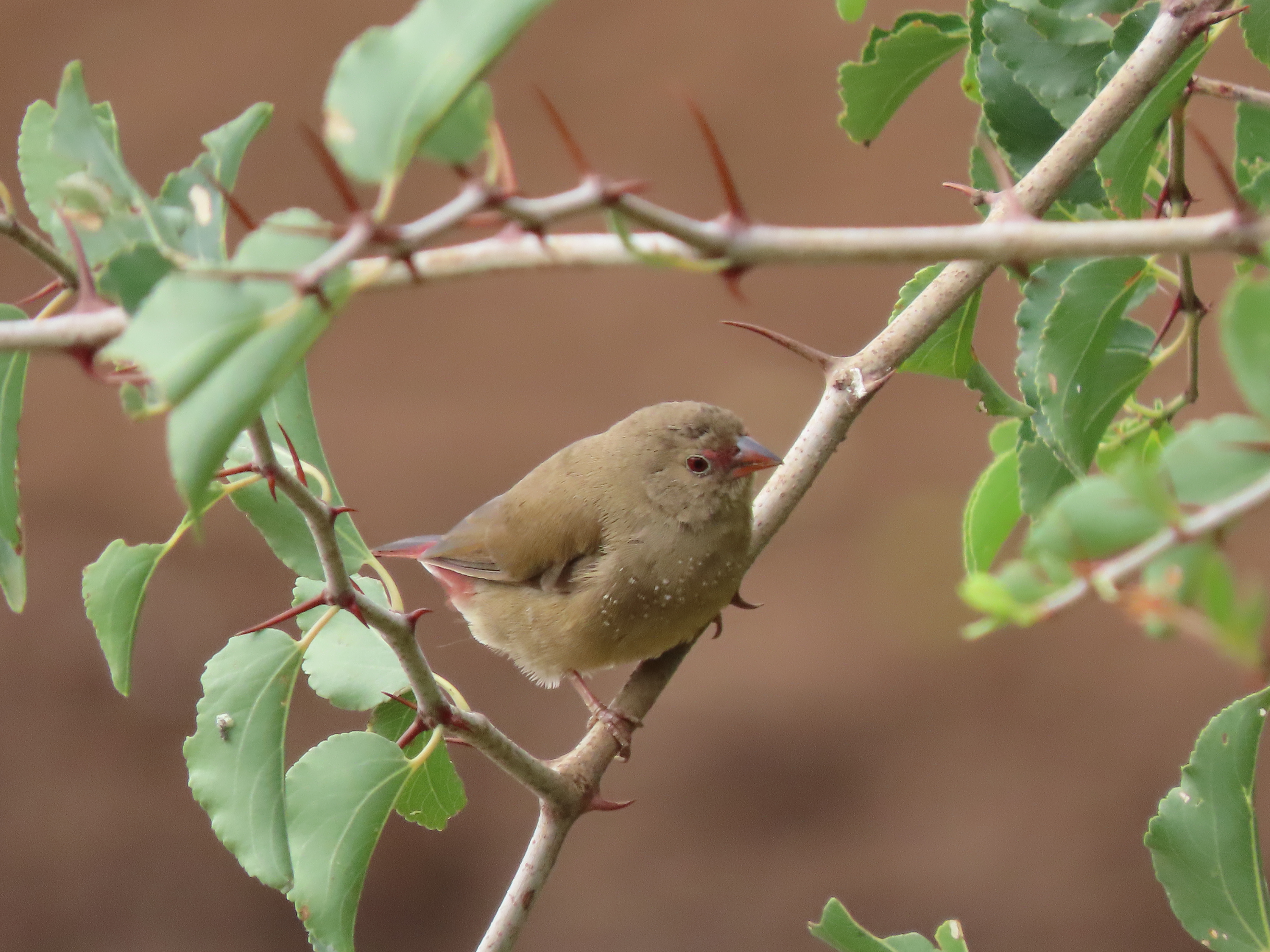
Shortly after arriving at Parfuri the heavens opened but fortunately we could take shelter under a massive thatch lapa while Rob rustled up a delectable breakfast. When the sun re-emerged so did the birds including this green-winged pytilia (much prefer Melba finch)...........
............a white-fronted lapwing with major wattles............
...........and another truly tawny, tawny eagle. The plumage is quite variable just to add a bit of a challenge.
Rob and Sean left on a Saturday morning and as I was loth to follow, I headed south to Letaba for a final night. There had been severe flooding in the far south and even the Letaba River was well up from it's usual trickle.
When I arrived back and checked mail, I discovered that the previous day I had driven over a bridge where a flock of our regions rarest bee-eaters had been found a day earlier. I wasn't too concerned as white-throated bee-eaters rarely hang around for more than a day or two, but this crowd stayed so it was back to Punda. I left on a Sunday and could not make a reservation so just took a chance and headed out at 3.30 am. Around six I pulled into a One-Stop for coffee and a muffin and was at the gate by 11.30
Fortunately there was a room available but it hadn't been made up so I set off for the 50 km drive to a small bridge between Punda and Shingwedzi. Actually saw this little biosphere on the way but figured I 'd find the birds first then come back for pictures. Of course I missed it and the birds so it had to wait till the following morning. While driving along the for second time I idly wondered if anyone else was on the road looking out for ellie crap!
Needless to say the next two visits proved fruitless though there were plenty of people who had seen them earlier or the day before. Some consolation was this little pearl-spotted owlet.
Took another drive up to Klopperfontein dam and this time found a turtle surfing on a hippo's back. It had it's legs in the air and I could almost hear it going "wheeee". Sure enough a while later the hippo gave a mighty shake and off it went.
Can never resist a southern red bishop in it's ecclesiastical finery.
Along the roadside little clumps indigofera ( I. heterophylla, I think) added a dash of colour.......
........and another that's hard to resist, a lilac-breasted roller giving it's harsh, grating call. When you are that beautiful who cares what you sound like.
After another unsuccessful visit to the site, the Mahoni Loop beckoned and this picturesque pod mahogany (
Afzelia quarzensis) looked amazing in the evening light.
Again decided on a night at Letaba which meant I could get to the site in the morning, go to Shingwedzi for lunch and back 12 km if I still needed to. When I arrived there were two vehicles and on enquiring was told that 4 birds had just flown but were bound to come back. They didn't. After 2 hours I went and had lunch then returned - again nothing. Win some and.....
Got to Letaba and was entertained by this very vocal woodland kingfisher and a couple of toots later was over the lack of bee-eaters. Set off for home just after 6 am and here's a very good reason not to follow Google Maps advice too closely. I should have turned back and gone around on the longer route after the first couple of kilometers but stupidly went on. An hour later I had done 35 kms!
'
Came up the Abel Erasmus Pass and recent heavy rains had turned what is normally a trickle into this.
There's a One-stop called Alzu on the N4 which has to have the best loo-view in the world. Stand at the gents urinal and this is what confronts you.
Had to get a close up, there must be 20 rhino, 50 buffalo, eland, oryx and wildebeest. Forget Kruger 10 minutes here is all you need.